
Why Earn Your Graduate Degree from Lehigh?
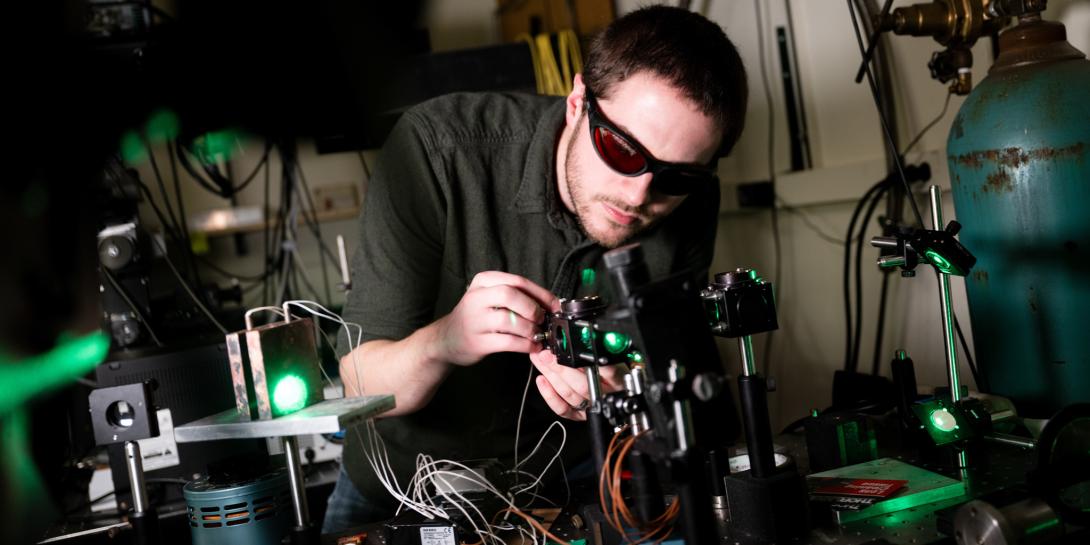
With highly advanced research facilities available to you, there’s nothing to hold you back from embarking on a career at the forefront of modern science. In Lehigh’s physics department, you will engage in cutting-edge research, access state-of-the-art instrumentation facilities and work closely with professors who are known internationally for their expertise in the field.
On this page:
- Ph.D. in Physics
- M.S. in Physics
- M.S. & Certificate in Physics & Data Science
- Careers
- Financial Support
- How to Apply
- FAQs
Ph.D. in Physics
A rigorous, research-intensive foundation designed to cultivate independent scholars and scientific leaders at the forefront of modern physics. Combining advanced coursework in quantum mechanics, classical field theory, and statistical mechanics with immediate immersion in cutting-edge research, the doctoral program empowers students to push the boundaries of knowledge in areas such as astrophysics, soft condensed matter, biophysics, high-energy particle physics, optics, and computational modeling.
M.S. in Physics
A foundation master's degree consisting of a 30-credit curriculum designed to bridge advanced theoretical foundations with immersive, hands-on inquiry. Students engage in rigorous coursework spanning core physical principles—such as classical mechanics, quantum mechanics, and electrodynamics—while tailoring their degree through flexible electives across astrophysics, soft matter, optics, and computational modeling.
M.S. & Graduate Certificate in Physics & Data Science
An interdisciplinary program that merges physics with modern data science methods, with an emphasis on computation and foundational concepts in statistics and probability. It is designed to cultivate professionals capable of leveraging data-driven methods and computational tools to solve complex physical and engineering problems. The program prepares graduates for data-intensive careers in industry, government laboratories, and academia, as well as for doctoral study.
Curriculum
The following courses are open to all physics graduate students regardless of your specific degree program:
- Mechanics
- Quantum Mechanics
- Electricity and Magnetism
- Nuclear and Elementary Particle Physics
- Statistical Models in Data Science
- Machine Learning in Physics
Careers
Our alumni transition into leadership roles across the sectors of research, industry, and academia. Where are graduates work:
- Lockheed Martin
- National Institute of Standards and Technology
- U.S. Naval Research Laboratory
- Geisinger Medical Center
- Nokia Bell Labs
- CACI International, Inc.
Financial Support
We are committed to helping you finance your graduate education. In the physics department, these forms of funding are typically offered to Ph.D. students:
- Teaching Assistantships
- Research Assistantships
- Fellowships
How to Apply
Applicants to the physics programs must:
- Earn a bachelor’s degree from an accredited institution
- Submit an online application
- Provide official transcripts
- Submit a statement of purpose and current resume
- Provide 2 letters of recommendation
- English language proficiency, if applicable
Application Deadlines
- Applications and supporting documents are due by January 15 for fall enrollment.
Ready for the Next Step?
Apply to the Physics graduate programs via the online graduate application.
Request Information
Tell us a bit about yourself so our team can help you navigate deadlines, explore program highlights, and guide your next step.
FAQs about the Physics Graduate Programs
The master’s programs require 30-credit hours and can generally be completed in 4 semesters.
Ph.D. candidates typically complete the program in 5-7 years, culminating in a field-advancing dissertation.
The graduate certificate is a 12-credit program that can be completed as a stand alone credential or as a complement to a degree.
Graduate students in physics are actively involved in the scientific community, present their research at scientific conferences, and publish their findings in peer-reviewed journals. Students have access to a range of computational and experimental facilities, including those related to condensed matter physics, atomic and optical physics, biophysics, particle accelerators, and lasers.
The department offers courses and research opportunities in these specialized areas of physics:
- Astronomy and Astrophysics
- Atomic, Molecular, and Optical Physics
- Biophysics
- Computational Physics
- Condensed Matter Physics
- High Energy Nuclear Experimental Physics
- High Energy Theory
- Nonlinear Optics and Photonics
Over 90% of Lehigh graduate students receive robust financial funding, allowing you to focus on your research, training, and professional growth. Ph.D. students typically receive full funding (tuition and stipend) in these forms:
- Teaching Assistantships
- Research Assistantships
- Fellowships
Applications and supporting documents are due by January 15 for fall enrollment.