
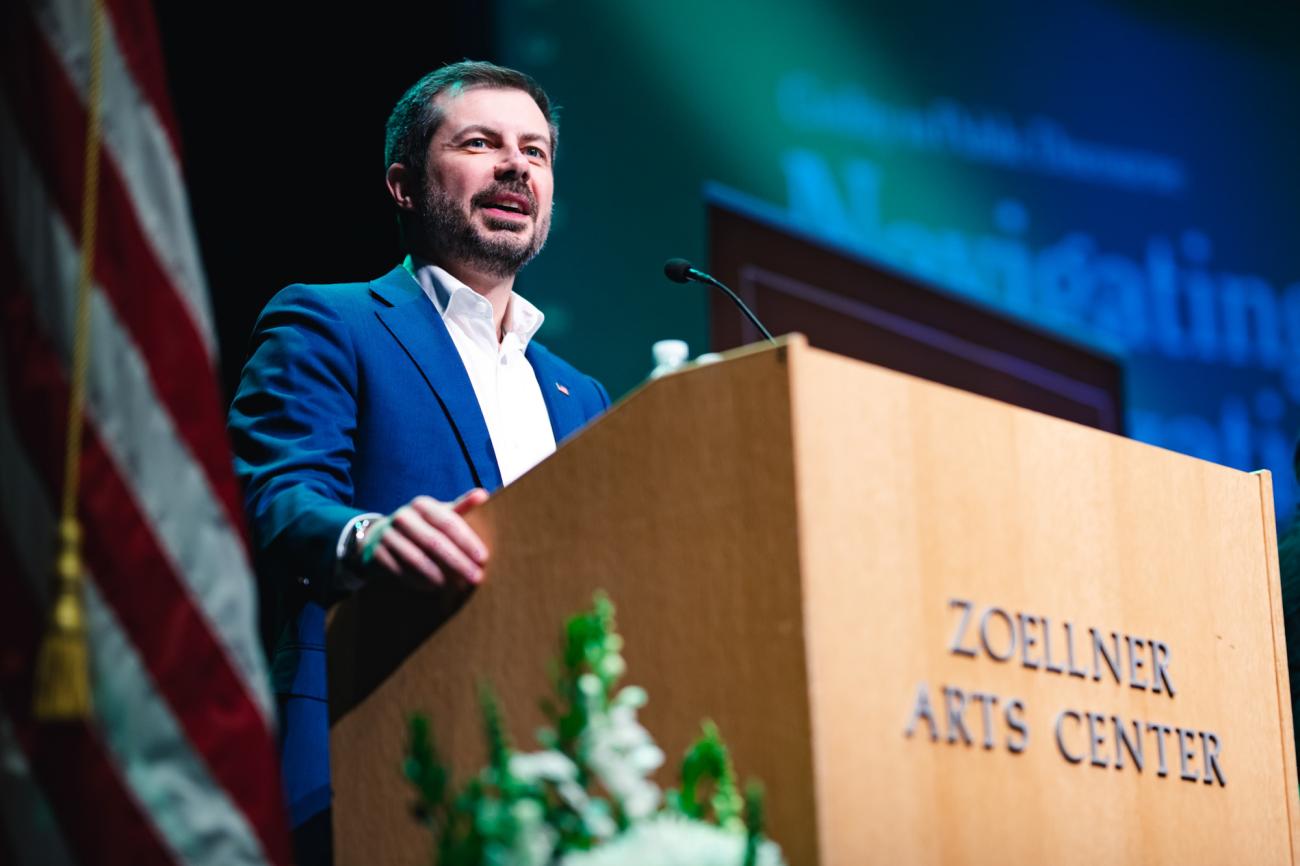
Pete Buttigieg Speaks About Family, the Future, and Finding Common Ground at the 2026 Kenner Lecture
The former U.S. Secretary of Transportation delivered an optimistic speech and urged attendees to imagine ‘what’s next’ as the speaker of the College of Arts and Sciences’ Premiere Lecture
On a cold and rainy night at Lehigh University, Pete Buttigieg opened the 2026 Kenner Lecture by remarking the weather and warm welcome made him feel right at home as a Midwest native of an industrial city. Buttigieg spoke for over 45 minutes on Tuesday to a packed audience in Zoellner Arts Center about family, the future, and finding common ground.
Buttigieg recalled that the last time he was in the Lehigh Valley was when he served as U.S. Secretary of Transportation and delivered transportation funds, like grants for Lehigh Valley International Airport (ABE), plus other transportation resources. During his tenure as secretary, he worked to launch over 70,000 infrastructure projects.
“It doesn't feel like it's been that long since I was doing that work, and yet how much has changed for our country,” he said. He noted how much has changed for him personally since leaving the Cabinet. “It's a very unceremonious transition,” he joked, recounting handing in his phone and computer to his security detail who was at his side for years. Yet, his role as father, the most important status in his life, didn’t shift.
The audience laughed as Buttigieg shared some of the more humbling experiences of being a parent to 4 ½-year-old twins, Gus and Penelope. His children, he stated, were an everyday reminder of how much is at stake. “They helped me realize just how much depends on us getting through this moment in one piece,” he said.
These moments of levity were followed by solemn truths as he drew attention towards current events. He noted the pressure universities, in particular, have come under to cross divides.
“I believe there is a moment here to reach out to people who have been on other sides of various controversies and establish common ground about some very fundamental things in our country,” Buttigieg said.
Buttigieg painted an unsettling picture of the state of America today, but asked the audience to consider, “Then what?” While acknowledging the difficulty of picturing the future when we are absorbed in the current moment, he urged attendees to imagine what comes next and compelled listeners to consider that action has to begin today.
He recounted growing up in his hometown of South Bend, Indiana, an industrial city marked by the collapse of the Studebaker Car Company in 1963. “We all lived with its ghosts,” he said, describing the hundreds of acres of abandoned and collapsed factory buildings on his way to school.
“I'm especially glad to be in this region of Pennsylvania where there's an experience that rhymes a lot with some of what we went through in my corner of the Industrial Midwest,” he said.
It was a city that “felt like it was on the brink” when Buttigieg was elected mayor of South Bend at age 29. It was perhaps easier for him, as someone in the younger generation, to imagine a future because he didn’t live through its industrial prime.
“It was possible to accept that the past was the past and demand that the future be better,” he said. He also outlined his experience building a coalition that crossed party lines.
“We need a vision for government and institutions that serves people better, not just better than now, but better than before,” Buttigieg remarked, listing an array of reforms and policies to tackle—the national budget, wealth disparity, artificial intelligence (AI), housing, infrastructure, clean energy, affordability, and education.
To do so, “we have to be grounded in our highest principles,” he said. “We need to be grounded in the importance of the everyday, which I would argue is what all politics is actually about. And I think we need to be grounded in our regard for one another.”
Buttigieg then recalled his time deployed to Afghanistan where the country’s lack of basic infrastructure and necessities are things Americans often take for granted. These fundamental things of everyday life—clean drinking water, food in the fridge, well paying jobs, healthcare, childcare, good roads—are “kitchen table issues.”
“I believe things would be healthier if we could build a politics of the everyday, where we all make clear what we are for and what we are against in ways that are clearly accountable to the dynamics of everyday life,” he said
Buttigieg returned to talking about his own family, remarking, “equality is very much a kitchen table issue at our house.” If it wasn’t for the landmark 2015 ruling on the 14th Amendment that granted same-sex couples the right to marry, he wouldn’t be married to his husband, Chasten, today.
While it may be easy to be paralyzed by the current state of our country, he said, we should, instead, be propelled to action—conflict fuels revolution. He pointed to major historical American moments defined by revolution—the American Revolution, the Civil War, the Great Depression, and the Civil Rights Movement. “When we consider those examples, we realize that our times are more precedented than we think,” he said.
It challenges us to face our own times with purpose and hope, he urged, and embrace that our time requires engagement. “Probably the wisest thing I've ever heard said about hope is that hope is the consequence of action more than its cause.”

Ziad Munson, professor of sociology, chair of the department of sociology and anthropology, and a native of the midwest like Buttigieg, moderated the Q&A. Munson started by addressing the title of the evening’s talk, “Civility in Public Discourse: Navigating Polarization and Uncertainty” and asked Buttigieg how to approach common ground in polarizing times.
“When I talk about common ground, I'm not suggesting that common ground always lies at the exact midpoint between where we imagine one side and the other side to be,” he said.
“We also need to make sure that we're practicing politics of addition and not alienating people who we are asking to maybe suspend a lot of things they really care about in the name of some other things that they really care about that we really care about too,” he concluded.
When asked about the value of civility Buttigieg remarked that we can’t agree to things just to keep the peace, mentioning the march in Selma during the Civil Rights Movement as a powerful example. “I don't want a call for civility to sound like a call for acceptance of what is unacceptable,” he said.
Prompted by Munson to explain how righteous rage might fit into a civil debate, Buttigieg acknowledged that anger is sometimes a valid human response to some of what’s going on right now. He made the point that politicians and activists may have different approaches to change, but that it doesn’t make their emotions any less valid if they are true to themselves.
The end of the evening broached the topic of truth. Buttigieg asked those in the audience under the age of 30 to raise their hands and then asked those with their hands raised to keep them raised if they got their information from traditional media like television. Only one person had their hand still raised. He used this as an example of our changing times and the state of journalism today.
With social media, “everybody's a reporter now,” he said. “We're going to know more than we did. And in a way it's true actually. We wouldn't know about the killing of Alex Pretti, the killing of Renée Good, or the killing of George Floyd if it weren’t for the fact that everybody can kind of be a reporter.”
Yet in such an information age, we’ve never been less informed, he remarked. “If everybody's a reporter, but nobody's an editor, you've got a problem.” We need to uphold journalistic standards and this power is in our hands—our thumb is voting on editorial policy with every swipe and every click.
Munson asked Buttigieg to give the audience things they can do to restore Congress as a functioning legislative branch to which Buttigieg responded by saying we need to set-up fair elections, stop gerrymandering, protest, call members of congress, vote, reform the supreme court, and keep money out of politics. “Some of these things might take years to deliver,” he said, but, “that is all the more reason to get working on them yesterday, and everybody here can be part of that.”