
Hands-On Innovation
Professors Lauren Scott and Christina Zhang bring circular construction, 3D-printed joints, and on-site problem solving to the fields of the original Woodstock.
The field of architecture is ever evolving, shaped by new materials, new tools, and educators willing to rethink what students learn by building. When architects talk about the lifecycle of a building, the conversation usually centers on blueprints, steel beams, and decades of permanence. For Lehigh University architecture professors Lauren Scott and Christina Zhang, preparing the next generation of designers means thinking just as carefully about how structures come apart as how they go together.
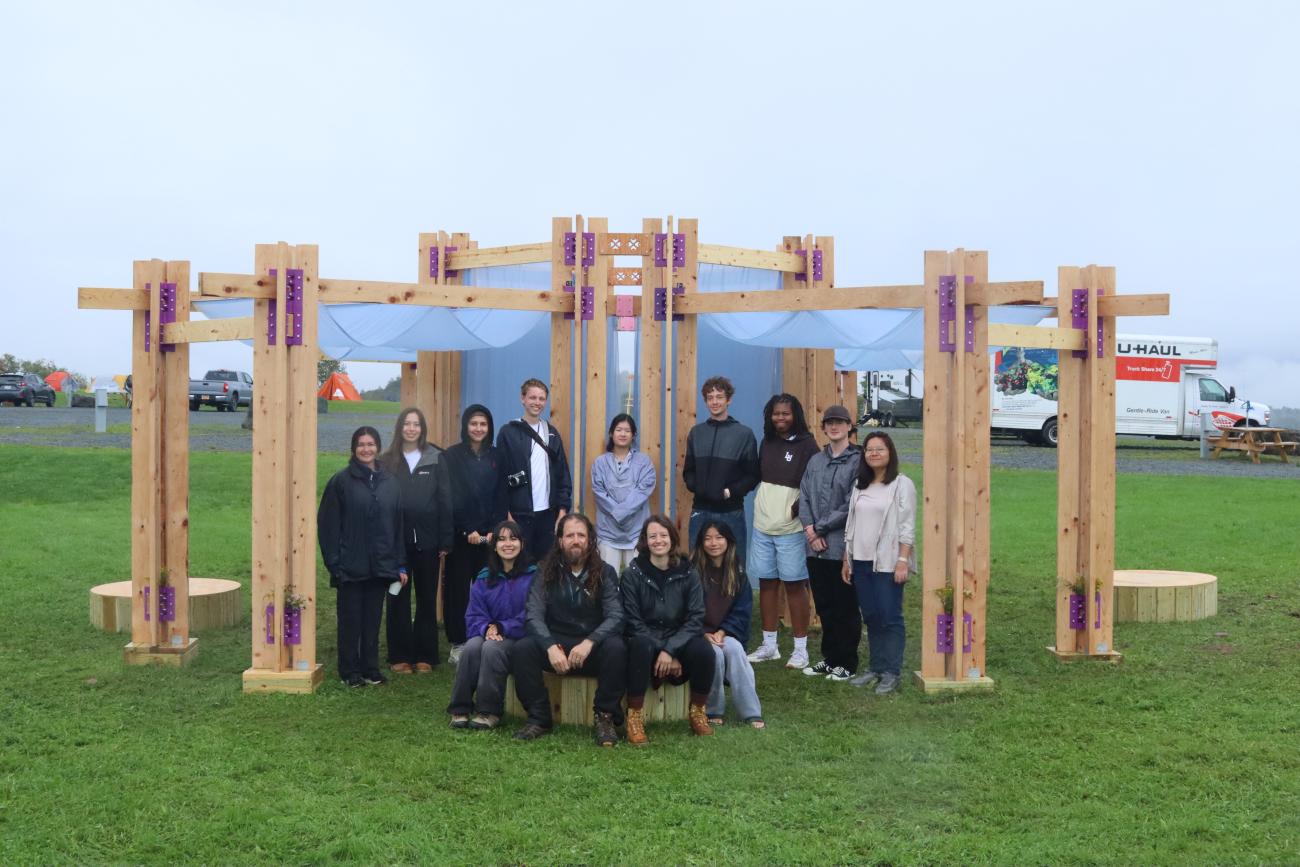
That philosophy took center stage this September at BuildFest, officially the Bethel Woods Art & Architecture Festival, held on the historic site of the 1969 Woodstock festival in Bethel, New York. The annual gathering brought together nearly 250 students and faculty from 15 institutions across the country, challenging teams to construct experimental wood-framed installations under tight timelines and rugged campsite conditions. For Scott and Zhang, it was an ideal setting to put cutting-edge design theory directly into students’ hands.
Designing for Disassembly and Material Lifecycles
The festival marks the first installment of a three-year curatorial initiative titled “Acts of Construction.” This year’s edition, called Act One: Staging, explored how the structures can accommodate different uses, performances and configurations, with future editions set to reuse and transform them. The theme asked teams to embrace circular construction, creating structures intentionally designed for disassembly, reuse or future activation. The idea echoes the original Woodstock festival, where immersive art installations emerged overnight and disappeared just as quickly. How do you build something memorable that leaves no waste behind?
Scott, Zhang, and their colleague Hannibal Newsom from Syracuse University, answered with Wildflowers, a cruciform framework of plus-shaped timber columns. The key to the installation was a custom, colorful 3D-printed joint engineered to hold four two-by-six wooden beams together using only nuts and hex bolts.
Why not screws? “If you use screws, it will cause degradation of the wood as you keep screwing and unscrewing,” Scott says. With nut-and-bolt connections, the timber can be taken apart by hand at the end of the installation’s life without damaging the raw materials, leaving them intact for use by other groups.
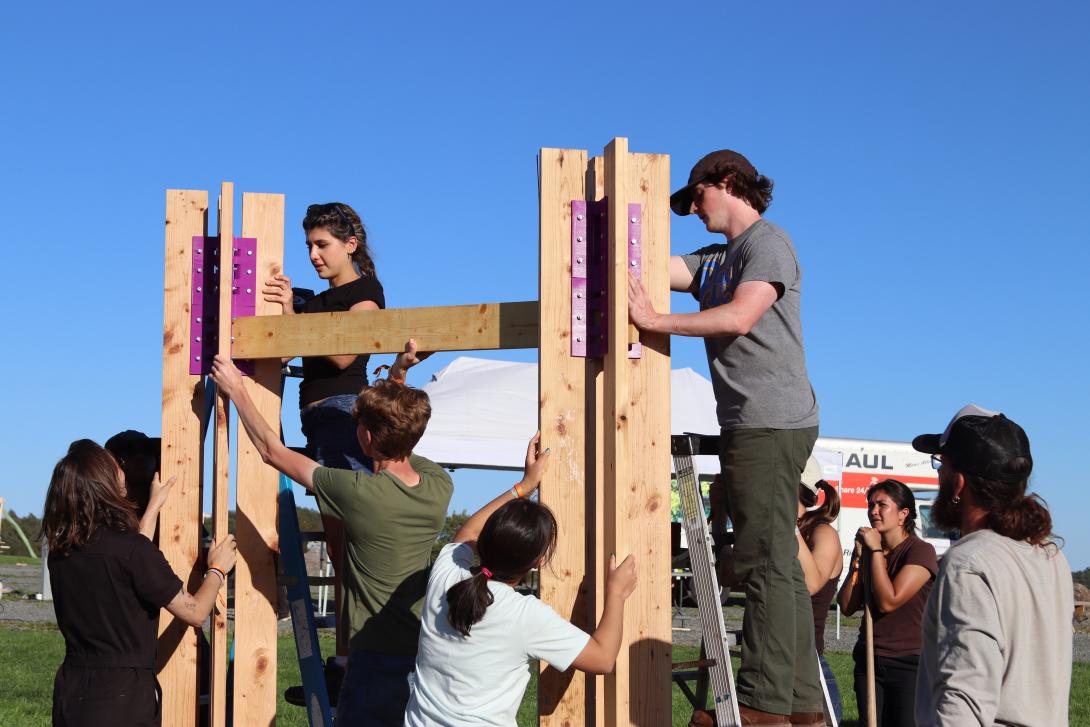
The faculty members also made a deliberate choice about how the project began. To make sure students were not put in the position of providing free labor, they submitted the initial design proposal themselves. Once it was accepted, they brought selected students into the fold to iron out construction details, such as calculate assembly sequences and physically execute the build on-site over a three-day sprint. The Lehigh students were also enrolled in a one-credit capstone course in which they documented and reflected on the process.
Problem-Solving on the Ground
Building in the field rarely goes strictly according to plan. Set on an uneven lawn, the team immediately had to adjust to the terrain.
“One of the tricky parts we ran into on site was that the site was not level,” Scott says. “So we had to figure out how to, just with our own hands and shovels, level a site. It was fun because the students got to see how we were calculating the slope and doing the math.”
The real test came when one of the installation’s timber columns crashed to the ground during assembly, shattering the 3D-printed joints. Rather than panicking, Scott and Newsom stepped in to show the students how to troubleshoot live, salvaging materials and replacing joints without losing momentum.
“They got to see us calmly and coolly and collectively figure out what to do and how to salvage what materials we could,” Scott says. “Students said that that would’ve been a very, very stressful experience had we not modeled a calm way to problem solve and keep it moving.”
For Zhang, the quick-turnaround build teaches essential professional lessons in precision, risk management, and contingency planning.
“You only have three days to build an entire structure,” Zhang says. “So a big part of the design lesson for students, especially because we’re fabricating across two institutions in Syracuse and at Lehigh, [is] the preciseness to allow for any type of mistakes or accidents on site—plan ahead to make sure that everything can progress no matter what happens.”
Despite rough weather, including 40-degree nights and severe thunderstorms that flooded tents, the atmosphere stayed celebratory. Evenings were spent around campsites with musical performances, light shows, and chances to connect with peers from schools as far away as UCLA and the University of Colorado Denver.
Translating Festival Lessons to the Classroom
The collaboration at BuildFest mirrors the academic ethos Scott and Zhang foster in their courses at Lehigh. Both professors regularly lead hands-on design-build courses that challenge students to create physical spaces that address real-world environmental and social challenges. Past student-led projects include Lehigh’s Wandering Bee installation and Scott’s Mobile Micro-Climate project for nearby Allentown, initiatives that show how architecture built by hand can directly shape local community life.
The students who traveled to Bethel were not chosen at random. “A lot of these students who joined us at BuildFest are students who did really well and demonstrated great management skills, drawing skills, problem solving skills, even photography skills during these design build courses,” Zhang says.
Ultimately, Scott and Zhang see these experiential builds as a way to democratize architecture and expand spatial literacy beyond traditional academia. Can a profession open its processes to people without specialized training?
“Another part of it... is thinking about how we as a profession can design and build and design processes such that everyone can participate,” Scott says. “It can be very inclusive; it doesn’t need to require specialized knowledge, intensive tools or costly materials. It’s thinking about how we can support spatial literacy and agency, using students as a test-bed for what non-experts can build.”
With Wildflowers on display at Bethel Woods through November, both professors look forward to continuing their cross-institutional collaboration and bringing more students back to the historic fields for future editions of BuildFest. What happens to a structure designed from the start to be taken apart? For Scott and Zhang, the answer is a classroom that never runs out of lumber, or lessons.